
Flashsale System
A backend for flash sales thousands of buyers, limited stock,one second. Built twice: synchronously, then queue-based.
Keeping stock correct under load.
Two implementations of the same flash-sale backend: one completes the purchase inside the request, the other reserves stock and queues the work. I compared them after auditing 21 defects in the original implementation and report.
HTTP error rate under peak load
300 virtual users · 108,844 requests
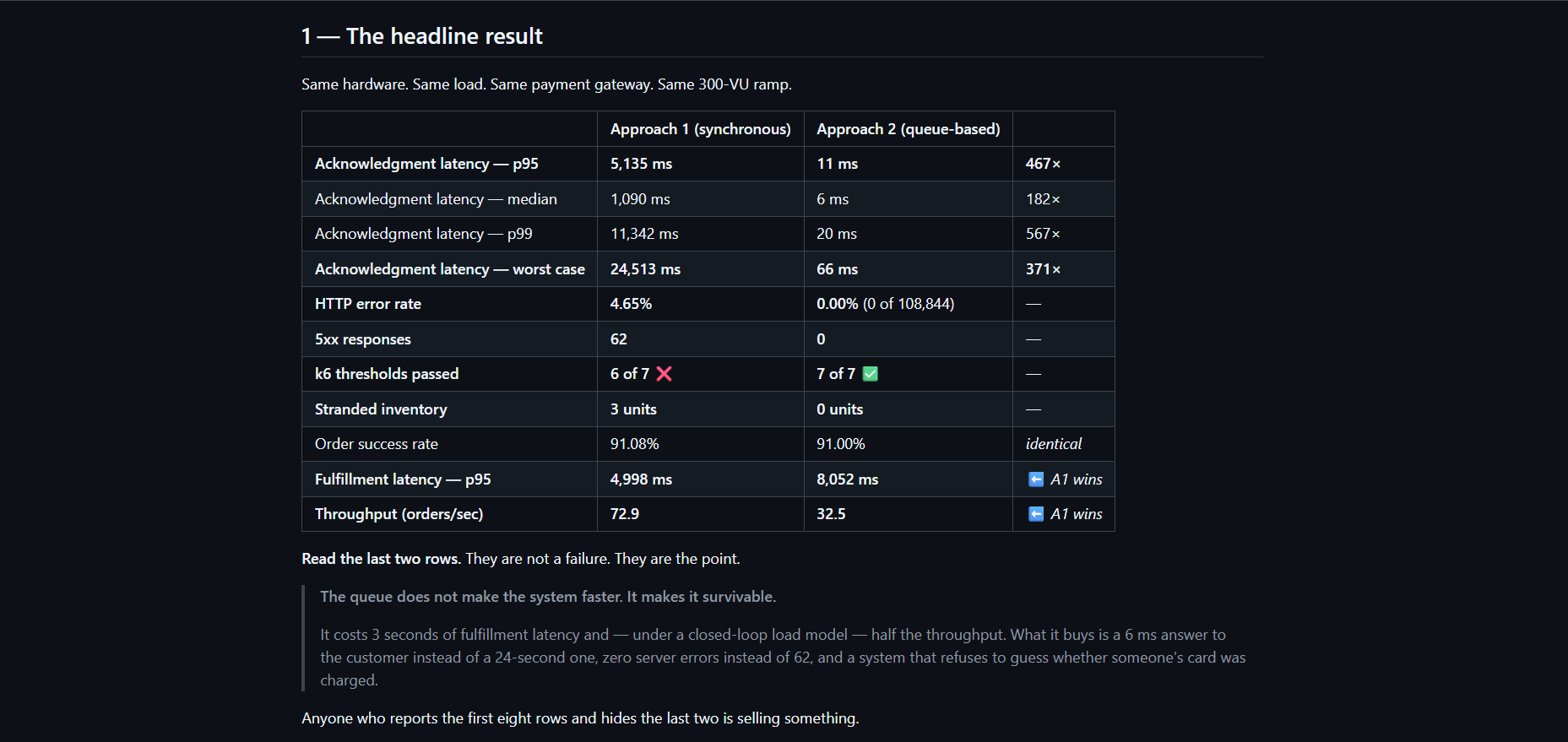
HTTP error rate dropped from 4.65% in the synchronous run to 0.00% in the queue-based run under the same load profile.
Acknowledgement and completion.
The queue returned an earlier response and recorded fewer request errors. It also took longer to fulfill orders and completed fewer orders per second in this closed-load test.
- 300 peak VUs
- Same hardware
- Same payment test service
- Identical thresholds
| Metric | SyncA1 | QueuedA2 |
|---|---|---|
| HTTP response latency | ||
| Median (ms) | 1,090 | 6 |
| p95 (ms) | 5,135 | 11 |
| p99 (ms) | 11,342 | 20 |
| Worst case (ms) | 24,513 | 66 |
| Errors and inventory | ||
| HTTP error rate | 4.65% | 0.00% |
| 5xx responses | 62 | 0 |
| Stranded units | 3 | 0 |
| Completed orders | ||
| Order success rate | 91.08% | 91.00% |
| Fulfillment p95 (ms) | 4,998 | 8,052 |
| Throughput (orders/s) | 72.9 | 32.5 |
Different response milestones. The synchronous response arrives after purchase processing. The queue returns 202 Accepted after reservation and enqueueing. The 467× ratio describes that HTTP-response difference.
The queued run recorded 108,844 HTTP requests with a 0.00% HTTP error rate. Order success remained around 91% in both runs. These results describe the reported 300-VU test; the fulfillment and throughput costs remain part of the comparison.
Separate reservation from confirmation.
The admission counter and the confirmed-order record answer different questions. Keeping their responsibilities separate is what protects pending reservations.
- Redis / Can another order enter?
- The reservation counter uses atomic
DECRandINCR. A reserved unit stays accounted for while its order is pending. - Postgres / What actually sold?
- Order records and conditional stock updates track the database side of the purchase. Confirming payment must leave the Redis reservation counter intact.
Payment succeeds
Confirm the order. Leave the reservation counter unchanged.
Card is declined
Release the reservation with
INCR.Payment times out or remains unknown
Hold the reservation and mark the order
needs_reconciliationfor human review.
redis_stock+ pending_orders+ confirmed_orders= initial_stock21 defects. Six findings worth examining.
An earlier report claimed a 42× latency gain under “100,000 concurrent users.” Auditing it against the implementation uncovered 21 defects. This page uses the post-audit measurements above; the earlier claim is not its benchmark.
-
Idempotency cached the wrong outcome.
CriticalThe middleware deleted the cached response on success and cached it on failure. A retry after success consumed another unit of stock; a transient failure could block retries for the rest of the five-minute sale.
-
Confirmation erased pending reservations.
CriticalThe payment worker overwrote Redis's reservation counter with a value from Postgres. Pending reservations disappeared from the admission calculation, allowing approximately 146 excess orders against unavailable stock during testing.
-
The worker's stock check had only moved.
HighThe report said the stock re-check had been removed. The code had moved it from Redis to a Postgres
SELECT … FOR UPDATE. Payment workers still serialized behind one row lock, which was also preventing actual overselling. -
The lock window caused the collapse.
HighThe original synchronous path held a row lock across multiple round-trips. Replacing the read, compute, and write sequence with
UPDATE … WHERE stock > 0 RETURNINGshortened the critical section without changing the architecture.Earlier stock-correctness retest: the faulty run sold 184 of 1,000 units; the corrected path sold 1,000 of 1,000. These counts are separate from the controlled A/B results above.
-
Thrown errors leaked reservations.
MediumTwo operations could throw between reserving stock and handing the order to the queue. Either failure could strand the reservation. An explicit ownership flag made the release path depend on whether the request still owned that reservation.
-
Schema changes raced at startup.
Mediumsequelize.sync({ alter: true })ran in four clustered API workers at once. Concurrent schema changes dropped constraints another worker expected, triggered crashes, and invalidated earlier benchmark runs.